

ISO 27001 risk assessment: protecting assets beyond the checklist
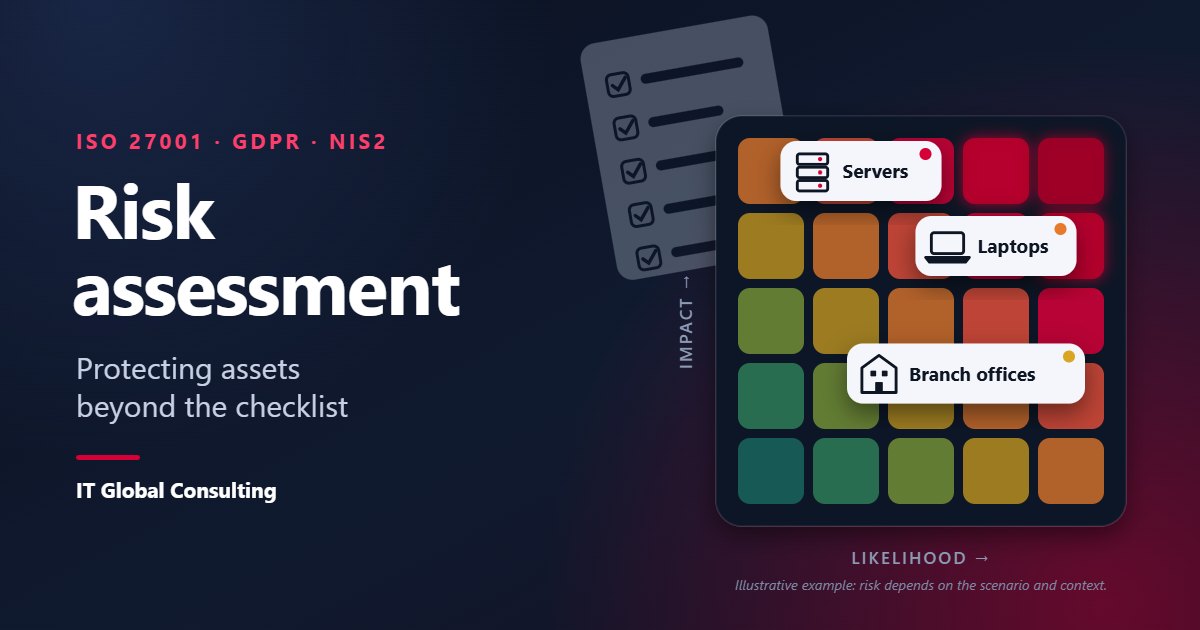
In many small and medium-sized businesses, information security is still seen as applying a rigid list of rules, the same for every device, every site and every person. Day-to-day operations tell a different story: security controls are not labels to be applied uniformly, but targeted responses to specific risks, which a well-designed risk assessment helps to identify. A laptop given to a salesperson on the road and a central server holding the company backups cannot be protected using the same approach, because their exposure and impact are different.
For those who run IT or make decisions in a company, a mature approach means moving away from a "one-size-fits-all" approach and adopting risk-based management that is practical and sustainable over time.
Not all assets carry the same weight
When deciding how to protect a company asset, people often look at the physical object rather than its information value. The real weight of an asset depends on the data it holds and the systems it gives access to.
Take the concrete case of a company laptop lost or stolen on a business trip. Losing a laptop is still an incident to be recorded and handled (for example by revoking credentials): disk encryption and multi-factor authentication (MFA) for access can reduce the risk, which must still be assessed considering the data stored, whether it can be recovered, the state of the device and any active sessions. By contrast, an unencrypted laptop may allow whoever gets hold of it to access the local data; and if VPN or cloud application credentials are saved in the browser, the device can become a way into company systems. In that case there is a possible personal data breach, to be assessed for notification to the Italian Data Protection Authority (in Italian): where required, notification must be made without undue delay and, where feasible, within 72 hours of the controller becoming aware of the breach (Article 33 GDPR).
At the other end of the scale is the central server hosting business applications or backups. Here physical loss is generally less likely than with a laptop, but the impact of an outage or compromise is critical: it is not a matter of losing a few files, but of bringing the whole company's operations to a halt. Different needs therefore call for different protections: disk encryption and remote wipe for laptops; isolated backups, redundancy and access control to technical rooms for servers.
Branch offices and network segregation
The same principle of proportionality applies to a company's locations. The head office usually concentrates the strategic systems and requires well-structured physical and logical barriers. Branches, warehouses and outlying stores differ in size and exposure and may have different physical and organisational safeguards, to be assessed in context, while being connected to the same network and applications as the head office.
Consider a sales branch connected to the head office over the company network. If a computer at the branch is infected with malware through a phishing email, the lack of separation between networks can help the attack spread to the central servers. Protecting a branch does not mean applying less security, but choosing targeted controls: training and software updates are a common baseline, to be adapted to roles, systems and risks, while at the technical level network segregation is used to help contain local incidents and limit their spread to other systems.
A complete inventory, assessment by group
Faced with these differences, many IT departments are tempted to analyse the risks of every single device and every single room in great detail. In SMEs, however, an overly fragmented analysis can absorb resources without proportionately improving the assessment: you may end up spending more effort updating spreadsheets than actually protecting data, and producing documents that are out of date within a few months.
This does not mean giving up the inventory: knowing which assets you have remains essential, and ISO/IEC 27001 includes it among its controls. The risk assessment, on the other hand, can be organised by homogeneous groups, where their characteristics and context allow, while keeping the necessary in-depth analysis. The following references govern different aspects of risk management:
- ISO/IEC 27001: the 2013 edition did not prescribe a device-by-device risk analysis; the standard requires a consistent assessment of the risks associated with the loss of confidentiality, integrity and availability of information within the scope of the management system.
- ISO/IEC 27005: describes asset-based and event-based approaches for identifying risks and building scenarios; the level of detail should be chosen according to the context.
- GDPR (Article 35): allows a single data protection impact assessment (DPIA) to address a set of similar processing operations that present similar high risks.
- ACN (Italian National Cybersecurity Agency): for NIS entities, ACN Determination no. 379907/2025 sets out mandatory basic specifications, with separate security measures for important entities (Annex 1) and essential entities (Annex 2).
Risk assessment in 4 steps
Simplifying does not mean lowering your guard, but making informed, documented decisions shared with those responsible for business processes. To set up practical risk-based management in a mid-sized company, you can start with four operational steps:
- Identify what really matters: map the company's main processes and identify the information and services whose unauthorised disclosure, alteration, loss or unavailability would have significant consequences for the organisation or for individuals.
- Define homogeneous asset classes: starting from the inventory, group devices, systems and sites with similar characteristics and level of exposure, while keeping specific assessments for critical assets or those with particular risks.
- Define reference security measures for each class: set the minimum measures for each group, the so-called baseline (e.g. encryption and MFA for all laptops, segregation for branch networks, isolated backups for servers). These are controls to be combined according to the risks, not protections reserved for one category.
- Formalise choices with management: document the criteria adopted and have the risk owners approve the risk treatment plan and accept the residual risks, turning security from a technical formality into a clear and defensible governance choice.
Security is not a checklist to be filled in automatically, but an ongoing commitment to a clear method and accountability. Starting from real risks makes it possible to focus resources where they are really needed and to show customers and auditors why each asset class is protected the way it is.
How IT Global Consulting can help
We can help you set up or review your risk assessment and security measures, bringing together ISO/IEC 27001, the GDPR and, where they apply, NIS2 obligations. Find out more about our cyber security services and our NIS2 consulting, or get in touch.
Discover the other news
The IT Global Consulting blog Explore, Learn, Innovate

Do you have questions about our services? We're here to help!
Our team of experts is ready to listen to your needs and to offer you solutions tailored to your business.
Fill out the contact form. We will get back to you as soon as possible to discuss how we can support you in the transformation of your IT infrastructure.
Partners


